Ultra-Broadband Lightweight Reflective Optics for Multispectral Sensing
Full Description
Unmet Need:
Traditional glass-based refractive optics suffer from material dispersion that prevents different wavelengths from focusing at the same depth. This physical limitation forces engineers to use heavy, expensive, multi-element assemblies to align visible and infrared light onto a single sensor. Current refractive systems cannot achieve simultaneous high-resolution focus across the full 400-1700nm range required for advanced AI-driven material classification and autonomous vision.
Technology:
Computational Mirrors is a broadband imaging framework that uses simple reflective optics and a physics-inspired reconstruction algorithm to capture all in-focus imagery from 400nm to 1700nm.
The system utilizes a primary concave mirror to focus light across a wide spectral range without the color blurring common in glass lenses. A motorized stage captures a sparse focal stack of 2-4 images to sample the curved Petzval image surface produced by the mirror. The SeidelConv algorithm applies learned affine transformations and blur kernels to mathematically correct spatially varying distortions like coma and astigmatism. This process enables the fusion of a few blurred exposures into a single sharp image across the entire field of view without requiring wavelength-specific refocusing.
Advantages
- Ultra-lightweight design - the system reduces objective weight by over 85% because it replaces heavy multi-element glass stacks with a single, 60g, mirror assembly.
- True broadband performance - continuous imaging from 400nm to 1700nm is possible because reflective surfaces are inherently achromatic across the entire spectrum.
- Superior off-axis resolution - sharpness is maintained to the edges of the frame because the SeidelConv model mathematically compensates for geometric distortions inherent in curved mirrors.
- Operational simplicity - the system eliminates the need for manual refocusing when switching between visible and infrared modes because the mirror focuses all light to the same focal surface.
- High light throughput - faster shutter speeds and better low-light performance are achieved because the simple mirror design supports high apertures (up to F/1).
Suggested uses
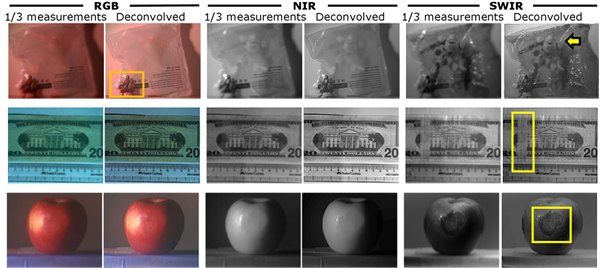
- Industrial inspection - the ability to see through certain opaque polymers allow for the non-destructive verification of contents.
- Autonomous systems and drones - significant weight reduction compared to glass optics improves flight time and payload efficiency for multi-spectral remote sensing.
- Environmental monitoring - real-time differentiation between live vegetation and artificial material enhances the accuracy of land-use surveys and camouflage detection.
- High-throughput inspection of produce - enables the detection of subsurface bruising that is invisible to standard color cameras.
- Forensics and authentication - cross-spectral imaging reveals hidden security features in currency and legal documents by comparing visible and short-wave infrared (SWIR) signatures.
Stage of Development
- Experimental prototypes (50mm F/1 and 100mm F/2 systems) have been validated in laboratory and outdoor environments.
Related Materials
Patent Status
Patent Pending
Contact
- Venkata S. Krishnamurty
- venkata.krishnamurty@ucr.edu
- tel: View Phone Number.

Other Information
Keywords
reflective optics, VIS-SWIR imaging, Seidel aberrations, computational photography, material classification, focal stacking, achromatic vision

