Methods For Measuring Telomere Length
Background
Telomere length is often measured by Southern Blot (invented in 1973). This method measures the length of all the telomeres in the cell and does not give quantitative information or information about individual telomere lengths. A quantitative PCR method was developed however it has many problems with reproducibility across different labs. The Single Telomere Length Analysis (STELA) method and the related Telomere Shortest Length Assay (TeSLA) targets individual telomeres, but the use of high cycles of PCR generates bias for shorter products.
Thus, there are currently no methods that provide an accurate, high throughput, and simple approach for quantifying telomere length.
Technology Description
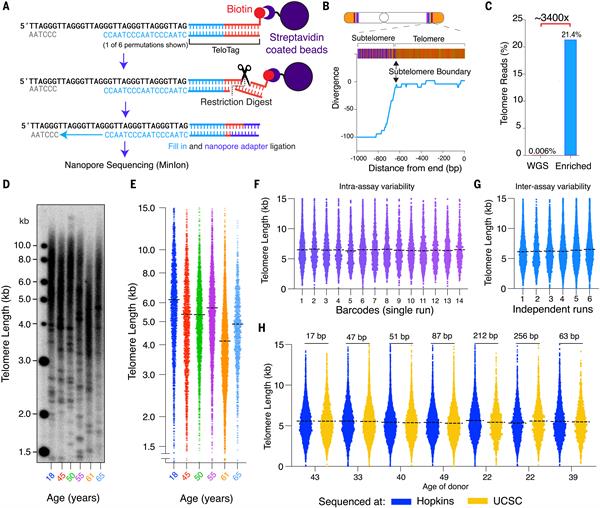
A telomere tagging probe with a biotin adapter is contacted with a splint oligonucleotide that binds to both a telomere and the telomere tagging probe.
The bead is isolated and the tagged telomere sequence is recovered. The tagged telomere sequence can then by analyzed by any of a number of methods to determine the telomere length.
The above figure depicts the following:
(A) Schematic depicting the Telomere Profiling enrichment method. Telomeres are tagged with a biotin adapter (TeloTag), enriched by streptavidin pull-down, and sequenced. (B) Subtelomere boundary is identified using an algorithm, TeloBP, that detects substantial deviation from the telomere repeat pattern. (C) Comparison of Telomere Profiling versus whole genome sequencing (WGS). (D) Southern blot of telomere lengths from six individuals of different age. (E) Telomere length measured by Telomere Profiling for the same individuals as in (C) (total reads = 21,556). The dashed line represents the median telomere length of each distribution. Each point represents a single telomere read. (F) Intra-assay variability: Telomere length from a single donor was measured 14 times on a single flow cell (total reads = 13,256). (G) Interassay variability: Telomere length measured from a single donor across six different flow cells (total reads = 19,230). (H) Telomere length profiles from the same samples generated in two different laboratories, Johns Hopkins University (blue) and the University of California, Santa Cruz (gold). The difference in telomere length in base pairs is shown at the top.
Karimian et al, Science 384, 6695 533-539 (2024)
Applications
Genomic sequencing
Diagnosing diseases involving telomere length
Studying telomerase enzyme in cellulo and in vivo
Advantages
Highly accurate, rapid, repeatable, and easy to perform.
Works well with nanopore sequencing
Intellectual Property Information
| Country | Type | Number | Dated | Case |
| European Patent Office | Published Application | 4581367 | 07/09/2025 | 2024-772 |
Additional Patents Pending
Related Materials
Contact
- Jeff M. Jackson
- jjackso6@ucsc.edu
- tel: View Phone Number.

Inventors
- Greider, Carol W.
Other Information
Keywords
telomeres, telomere length, nanopore sequencing, long read sequencing, TeloTag, telomere sequence enrichment

